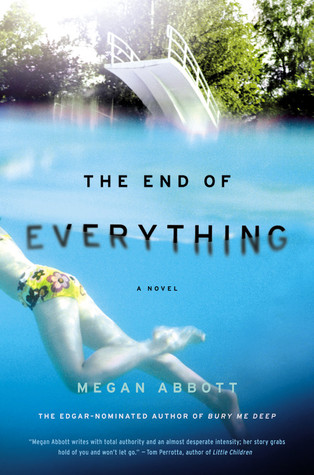
The End of Everything by Megan Abbott (Regan Arthur Books, 2011)
I’m a sucker for an unreliable narrator. And what could be more questionable than a 13-year-old girl’s account of the mysterious disappearance of her best friend?
Lizzie Hood, your average suburban middle-class tween is suddenly not so average when her best friend Evie goes missing one day after school. Overnight she becomes the closest link police have to the missing girl and the crutch Evie’s father leans on in her disappearance. She must know something, maybe she just doesn’t recall it, but she must know something. In her efforts to uncover the truth about Evie’s disappearance, Lizzie treads closer and closer to an adult world she can’t quite comprehend, the violence of desire and the lengths she’s willing to go to bring her friend back.
Megan Abbott writes crime thrillers so you might be surprised to find out that the actual crime here is secondary to the story. What Abbott really focuses on is the insidious relationship that brews between young girls and the older male figures in their lives. This is a line Abbott toes throughout the book and then casually stomps right over.
The most curious part is the agency the girls have. It’s Lizzie who puts herself in compromising positions with Evie’s father, Lizzie whose desire for a father figure—or maybe to be part of Evie’s family—moves her to command his attention in any way that she can. The father is supposedly so grief-stricken that he either can’t see what’s happening or perverted enough to see how far she’ll take it. Both Evie and her sister, Dusty, are equally fulfilling their own destinies. There are no adults in The End of Everything; there are teenagers stumbling into maturity and parents who refuse to take responsibility for themselves or the impact they are having on their kids. And the kids? The kids aren’t taken…they go willingly.
It has tinges of Lolita but told through the eyes of the Lolita that Humbert imagines. As though, any young girl would want that. But, then, maybe I just didn’t grow up in the same suburbia that they did. If you’re looking for a hard-to-put-down read you’ve definitely found it, but the story—and the dark slimy layers underneath it—aren’t as easy to abandon as the book is when you’re through.





 Lindsay Gloade-Raining Bird
Leave a reply to Kristan Cancel reply